
Toyota Urban Cruiser Review 2026



Toyota Urban Cruiser At A Glance

 Reasonably well-equipped. Larger dealer network than Suzuki. Chunky looks.
 Ride and handling are poor. Slow rapid charging rate. Small boot and limited rear legroom.
In launching the new Urban Cruiser, Toyota has brought back a name from its past, but applied it to a model that it hasn't had a great deal to do with. It's nearly identical to the Suzuki e Vitara, a car we weren't particularly impressed with, so there are inherent misgivings about this version despite the badge swap. Find out what they are in our full Toyota Urban Cruiser review.
Toyota loves collaborating with other manufacturers as several of its recent models confirm. On the sports car front, the Toyota GT86 and the Subaru BRZ are essentially one and the same, save for some minor styling differences, the GR Supra owed a lot to the BMW Z4, while its Proace series of vans are all built by the massive Stellantis empire.
Suzuki is another firm it has an ongoing relationship with, which so far has seen a couple of Toyotas badge-engineered without any technical differences. That saw the Toyota Corolla Touring Sports re-labelled as the Suzuki Swace, while the outgoing Toyota RAV4 became the Suzuki Across. Now the favour has been returned because the Toyota Urban Cruiser is a mildly altered version of the Suzuki e Vitara.
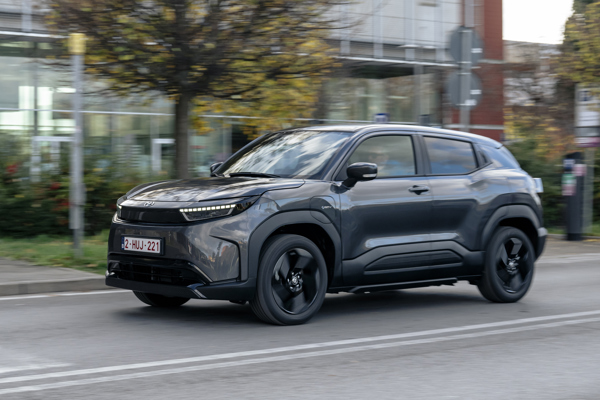
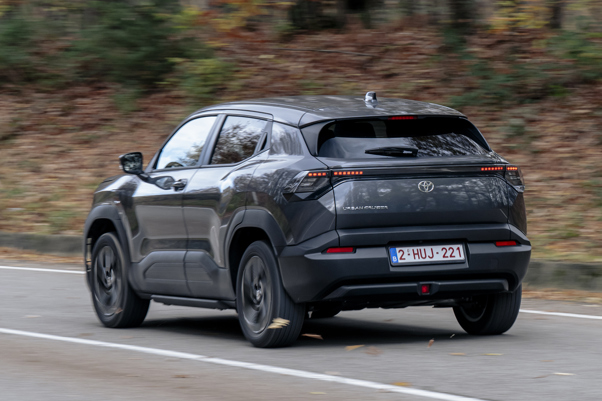
The two compact electric SUVs only differ in terms of badging and a lightly restyled front end. Whether you prefer one over the other is entirely subjective, but overall its looks aren't divisive and its chunky aesthetic helps it — well, both of them — stand out amid many other high-riding EVs available for a similar price.
Unfortunately, beyond this, the Urban Cruiser struggles to compete in a crowded marketplace. Even if you go for a version with the bigger battery as both the range and rapid charging rates are underwhelming — several rivals manage far better in both regards.
The Toyota doesn't make up for it in terms of practicality, managing only 244 litres of boot space if the sliding rear seat bench is in its rearmost position. It's not like the Urban Cruiser is especially cheap, starting at £30k, putting it in the same price bracket as far more talented rivals, including the Kia EV3 and the Skoda Elroq.
From the statistics alone the Toyota Urban Cruiser is off to a poor start, with matters going further south when you drive it. Toyota has entirely left the suspension set-up alone, meaning it suffers from the same ride and handling problems as the Suzuki.
Capping this all off, its on-board technology is really behind the curve, with a laggy touchscreen that must be relied upon for climate control functions and even turning the heated seats on and off. Are buttons too much to ask for?
As well as competition from myriad rivals, it doesn't help the Toyota Urban Cruiser's cause that Suzuki is discounting the e Vitara more heavily. Toyota claws back some ground by having a much more significant dealer presence in the UK, but unless it decides to drop the price the Urban Cruiser will remain difficult to recommend.
Toyota Urban Cruiser: Range and charging times
| Toyota Urban Cruiser 49kWh | 214 miles |
| Toyota Urban Cruiser 61kWh | 264 miles |
The Toyota Urban Cruiser is available with two different battery packs, the smaller of which is exclusively tied to the entry-level Icon trim. This 49kWh battery pack gives up to 214 miles of driving range according to the WLTP Combined cycle, which is very modest by today's standards.
Most will want to upgrade to the 61kWh battery, fitted to Design and Excel-trimmed versions. It's still not that impressive, though, offering up to 264 miles of range. Driven with exuberance we averaged just 2.5 miles/kWh, which would equate to more like 150 miles of range. Even with a gentler right foot, getting much over 200 miles from a full charge could be a tall order.
The Urban Cruiser doesn't make up for this with a high rapid charging rate. In fact, it's poor at only 70kW — compare that with Kia's EV3 which handles 102kW or 128kW, depending on the battery size. Using such a public DC charger, the Toyota needs 45 minutes to charge it from 10-80%, regardless of battery size.
Fully charging from flat using a 7.4kW AC home wallbox will take about 7 hours for the smaller battery and roughly 8 hours 30 minutes for the larger pack.
Reviews for Toyota Urban Cruiser's top 3 rivals





Toyota Urban Cruiser handling and engines
Toyota Urban Cruiser 2026: Handling and ride quality
How the Toyota Urban Cruiser drives is its most disappointing aspect, particularly the poor ride comfort which is seemingly in a constantly unsettled state.
Even when the road surface is relatively smooth, it harshly bounces over the smallest of imperfections and ties itself in knots over anything larger. It's not as if there's a payoff in terms of composure through corners with this setup as there's still notable degrees of body lean, while the whole car is jostled around by undulations at higher speeds.
To cap it all off there's a sense of vagueness to the steering that means you're never quite sure how much you need to turn the wheel. At least its weighting is about right.
Although there's no engine noise, the Urban Cruiser still isn't as quiet as it could be at higher speeds, with a fair amount of wind and tyre noise encroaching the cabin.
All-wheel drive versions of the Urban Cruiser aren't going to be sold in the UK, but light off-roading with front-wheel drive models is possible, aided by its decent of ground clearance, along with short front and rear overhangs.
Toyota Urban Cruiser 2026: Engines
Which battery size you choose for the Toyota Urban Cruiser determines how much power is produced by its electric motor.
Both are propelled by a single, front-mounted motor connected to the wheels using a single-speed automatic transmission. If you want this car with four-wheel drive than you'll have to go with the Suzuki e Vitara AllGrip-e
With the 49kWh battery there's 144PS available, while the 61kWh versions have 174PS, yet maximum torque is the same for both at 193Nm.
Those figures aren't especially impressive considering the Urban Cruiser can weigh up to 1839kg depending on specification, so inevitably, its 0-62mph times are nothing special. Toyota quotes 9.6 seconds for 49kWh versions and 8.7 seconds for the 61kWh-equipped cars. The entry-level Kia EV3, for comparison, producing 204PS and 283Nm manages the same acceleration benchmark in 7.5 seconds.
With the larger battery, the Urban Cruiser feels slower even than its modest 0-62mph yardstick suggests due to an annoying delay between putting your foot down and anything happening. Switching to its tokenistic Sport driving mode makes little difference.
Toyota Urban Cruiser 2026: Safety
As you might expect, the Toyota Urban Cruiser's Euro NCAP safety rating is carried over from the all-but-identical Suzuki e Vitara. It's decent enough at four stars, but many rivals managed the full five-star rating.
Breaking down into the individual categories, the Urban Cruiser is rated at 77% for adult occupant protection, 85% for child occupants, 79% for vulnerable road users and 72% for its driver assistance systems.
On the latter front, it comes with all of the usual suspects as standard, including lane-keeping assistance, traffic sign recognition, blind-spot monitoring and a driver attention monitor.
Toyota Urban Cruiser 2026: Towing
Regardless of whether the load is braked or not, the Toyota Urban Cruiser's towing capacity is modest at only 750kg. A detachable tow bar is a £649 option.
Toyota Urban Cruiser interior
Toyota Urban Cruiser 2026: Practicality
The Toyota Urban Cruiser's 306 litres of boot space is underwhelming compared with rivals such as the Kia EV3, which offers 460 litres, and the Renault 4 E-Tech, which is good for 420 litres.
There's a caveat to the Toyota's figure — you only get that with the rear seats slid as far forward as possible, which severely compromises legroom for those in the back.
Split in a 40/20/40 configuration, each element of the rear bench individually slides 150mm to and fro. Pushed all the way back you only get 244 litres of boot space. That's only 13 litres more than in the tiny Toyota Aygo X, the smallest model in its range.
Rear headroom is merely adequate, while up front the cabin isn't massively roomy. Interior storage areas are decent enough, with an okay-sized cubby under the front central armrest, a storage tray under the centre console and two cupholders above.
Toyota Urban Cruiser 2026: Quality and finish
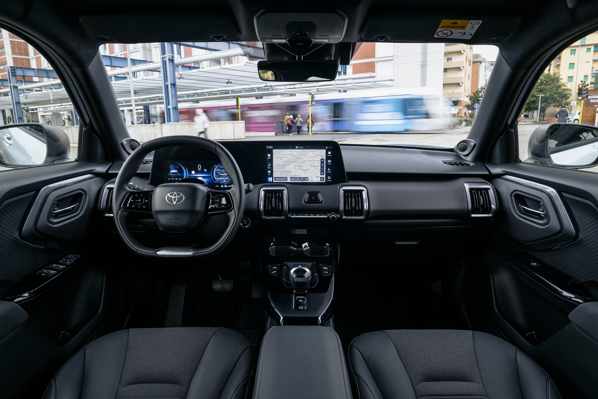
For a brand that has never exactly been high-scoring when it comes to feel-good interiors, the Suzuki-built Toyota Urban Cruiser is noticeably cheaper in terms of material quality and overall finish than its home-brewed models.
There are vast swathes of creaky and scratch-prone glossy black plastic, cheap-feeling textured trim on the door panels and a generally dreary atmosphere in the cabin. It does at least feel reasonably solid for the most part.
Toyota Urban Cruiser 2026: Infotainment
At first glance the Toyota Urban Cruiser's setup of a single, widescreen panel housing two screens — a 10.25-inch digital instrument cluster and a 10.0-inch touchscreen infotainment system — looks bang up-to-date. Start using the infotainment package and you soon realise it's a long way behind most rivals' packages.
It's laggy when you call upon it to perform a task, with annoying pauses being a consistent theme. It's particularly frustrating having to use the screen for climate control functions, especially when Toyota's own models have physical buttons to operate their systems. Even the heated seats are operated via the screen, requiring five presses of the display to alter.
Its navigation mapping looks dated and isn't the easiest to follow, but the Urban Cross does at least have wireless Android Auto and Apple CarPlay as standard, should you — understandably — want to avoid it in favour of Google Maps or Waze.
There's a premium JBL sound system fitted to range-topping Excel models, but it's nothing amazing.
Toyota Urban Cruiser value for money
Toyota Urban Cruiser 2026: Prices
The Toyota Urban Cruiser range starts with the £29,995 Icon, then it's £33,495 for the mid-range Design and £35,745 for the flagship Excel.
The Suzuki e Vitara starts at £29,999 and continues up to £37,799, only because you can have it in all-wheel drive configuration. That said, when it was launched Suzuki lopped £3750 off the car's price, matching the upper level of the government's Electric Car Grant (ECG). Neither it or the Toyota are eligible for even the smaller £1500 ECG discount.
We still think your money is better spent elsewhere, though. The Skoda Elroq starts at £30,210 once the ECG is factored-in, while it's £35,560 for the least expensive 82kWh version, making Urban Cruisers with the 61kWh battery pack look even poorer value. The Skoda is better built, far nicer to drive and goes nearly 100 miles further on a charge with its larger battery.
Then there's the Kia EV3, which is an excellent alternative even though it doesn't qualify for ECG. It starts at £33,005 and even though you're only getting the smaller 58.3kWh battery option for that, it also goes further on a charge than the rangiest Urban Cruiser.
Toyota Urban Cruiser 2026: Running Costs
Although the Toyota Urban Cruiser isn't as energy efficient as most of its direct rivals EVs, it should still prove cheap to run. For most UK households, it will cost about £13 to fully charge smaller battery versions and roughly £16 for those with larger packs.
It's possible to pay just a fraction of that if you're able to get on an EV-friendly variable tariff and time your charging sessions to coincide with off-peak periods.
You no longer escape paying VED Car Tax on EVs, so it's the same £195 for the Urban Cruiser as it is for any other petrol, diesel or hybrid car from the first anniversary of its initial registration.
Satisfaction Index
 What is your car like to live with?
We need your help with our latest Satisfaction Index, so that we can help others make a smarter car buying decision. What's it like to live with your car? Love it? Loath it? We want to know. Let us know about your car - it will only take a few minutes and you could be helping thousands of others.
Help us with the Honest John Satisfaction Index nowToyota Urban Cruiser models and specs
The Toyota Urban Cruiser is offered in three trim levels — Icon, Design and Excel.
The Toyota Urban Cruiser Icon comes with the following as standard:
- 18-inch alloy wheels
- 10.25-inch digital instrument cluster
- 10.0-inch touchscreen infotainment system
- Sliding rear seat bench
- Heat pump
- Adaptive cruise control
Upgrading to the Toyota Urban Cruiser Design introduces:
- Heated door mirrors
- Heated front seats
- Heated steering wheel
The range-topping Toyota Urban Cruiser Excel builds upon the above with:
- 19-inch alloy wheels
- LED headlights
- 360-degree parking cameras
- Panoramic glazed roof
- Synthetic leather upholstery
- JBL sound system
- Wireless smartphone charging pad
Model History
- September 2025: Toyota Urban Cruiser preview
- November 2025: Toyota Urban Cruiser on sale, prices start at £29,995
September 2025
Toyota Urban Cruiser preview
It seems it’s not just Ford and Vauxhall that are dredging their back catalogues when it comes to naming news models — this new small SUV is the Toyota Urban Cruiser, although consider yourself pre-forgiven if you weren’t aware that there’d been an earlier generation of it.
That first Toyota Urban Cruiser was more of a compact MPV than a tough-looking SUV but it wasn’t especially popular — sales ended over a decade ago after just four years on the market.
Rather than replacing the similarly sized Toyota Yaris Cross the new Urban Cruiser has a different role to play courtesy of it only being available as a full EV, with no combustion-engined alternative.
Neither is the Urban Cruiser all Toyota’s own work either — it’s been developed in conjunction with the Suzuki e Vitara with which it shares its underpinnings as well as various parts of its bodywork and interior.
From the front, the Urban Cruiser apes its showroom siblings such as the larger Toyota C-HR+ and bZ4X models, but from most other angles its relationship to the Suzuki is very apparent. Given this already happens with the Toyota RAV4 and Suzuki Across, it’s unlikely to cause either brand any difficulty.
Small electric SUVs are a huge growth area in the market with most brands already offering an alternative to the Toyota Urban Cruiser or, at worst, soon will be.
Newly launched is the Ford Puma Gen-E, the battery powered version of 2024’s best-selling car in the UK — expect these to become rather commonplace quickly. Another debutant the Toyota will have to face is the excellent Kia EV3 which so far boasts the longest driving range for cars of this size and type.
More established rivals to the Urban Cruiser include the tough-looking Jeep Avenger 4xe, the recently refreshed Vauxhall Mokka Electric and the excellent value Volvo EX30.
Three Toyota Urban Cruiser trim levels will be available which follow the brand's usual hierarchy of Icon, Design and Excel. Those first two will be available with front-wheel drive and powered by a 144PS motor fitted with a 49kWh battery.
There is a larger-batteried 61kWh alternative that also sends its 174PS of power to the front wheels, which will be exclusively sold in the UK in Excel specification. That same battery is also likely to be offered with all-wheel drive, which additionally enjoys a modest power increase to 184PS.
Equipment highlights for the Toyota Urban Cruiser Icon include 18-inch alloy wheels, wireless Android Auto and Apple CarPlay accessed via a 10.1-inch multimedia touchscreen, 12-colour interior LED lighting, a reversing camera and a blind-spot warning system.
Upgrading to Design grade adds a heated steering wheel and front seats, rear passenger air vents and automatically folding door mirrors. Stepping up to Excel specification adds 19-inch alloys, an upgraded JBL sound system, two-tone paintwork, a panoramic glass roof, a 360-degree camera system and adaptive LED headlights.
Toyota’s not yet offered any guidance — let alone official claims — on driving range or recharging times for the different Urban Cruiser variants.
Orders for the Toyota Urban Cruiser are expected to open in late summer 2025 with the first customer deliveries likely before the year’s end.
November 2025
Toyota Urban Cruiser on sale, prices start at £29,995
Toyota has announced that the Urban Cruiser will go on sale from 1 December, priced from £29,995. First deliveries of the electric small family SUV will start in the first quarter of 2026.
Three trim levels are available - Icon, Design and Excel. Icon includes 18-inch alloy wheels, a 10.1-inch multimedia display, 10.25-inch driver’s combimeter, a sliding rear seat system and an air conditioning unit with an energy-saving heat pump.
Design trim includes heated front seats and steering wheel, auto-retracting heated door mirrors and a windscreen wiper de-icer.
Range-topping Excel models add 19-inch alloys, a JBL sound system, wireless smartphone charger, a fixed glass sunroof, LED headlights, and a Panoramic View Monitor.
Two battery options are available. Icon models get a 49kWh battery with a range of 213 miles, while a 61kWh battery is fitted as standard to the Design and Excel versions, and has a range of 264 miles. Toyota claims a DC (67kW) charge should take around 45 minutes.
Toyota Urban Cruiser prices
Urban Cruiser Icon 49kWh battery £29,995
Urban Cruiser Design 61kWh battery £33,495
Urban Cruiser Excel 61kWh battery £35,745
